Benign skin lesions such as raised moles, keratoses, warts and age spots can be removed without surgery by vaporizing them layer by layer with laser energy. The procedure is quick and is planned to leave minimal marks.
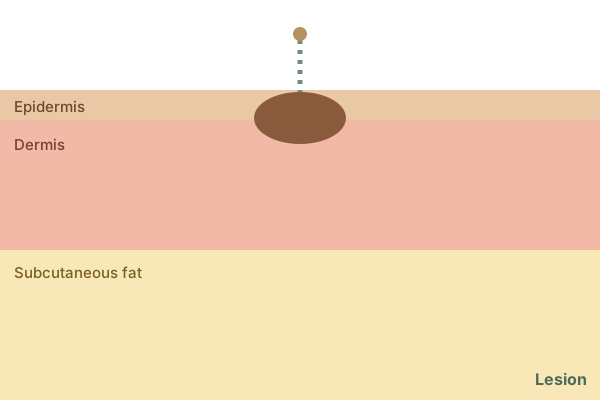
Ablative lasers (especially Er:YAG) are strongly absorbed by water in tissue. The tissue containing the lesion is vaporized with very little heat spreading to the surroundings, so the lesion is removed in thin layers with minimal damage to nearby tissue.
The depth is controlled by the doctor, which protects healthy skin and usually leaves a smooth surface after healing.
Important: laser removal is done only for lesions confirmed to be benign. Suspicious lesions, or those that change in color, shape or size or bleed, are examined first and, if needed, surgically removed and sent for pathology.
Raised moles judged to be benign on examination.
Raised or pigmented benign lesions that appear with age, such as seborrheic keratosis.
Superficial skin warts and similar small raised lesions.
The lesion is examined; those judged benign are suitable for laser, while suspicious ones are referred for surgical removal and pathology.
The area is numbed with local anesthesia and the lesion is removed with the laser. Depending on the number of lesions, it takes minutes.
Crusting and temporary redness may occur. Dressing, moisturizing and sun protection are advised; the crust should not be picked.
Deeply rooted lesions may recur, which is why correct lesion selection and appropriate depth matter.
Malignant lesions can look like benign moles. Because the laser vaporizes the tissue, it cannot be examined by pathology; suspicious lesions are therefore not removed with a laser.
It is planned to leave minimal marks, but scarring depends on skin type and lesion depth.
Contact our expert team and let us plan the right solution for you together.
Contact via WhatsApp Book an Appointment